How to read the Steelers board: moneyline, spread, total and the hold
What each number on a Steelers game page means, how the per-$100 column is worked out, what a fee does to a contract, and why the hold matters most.

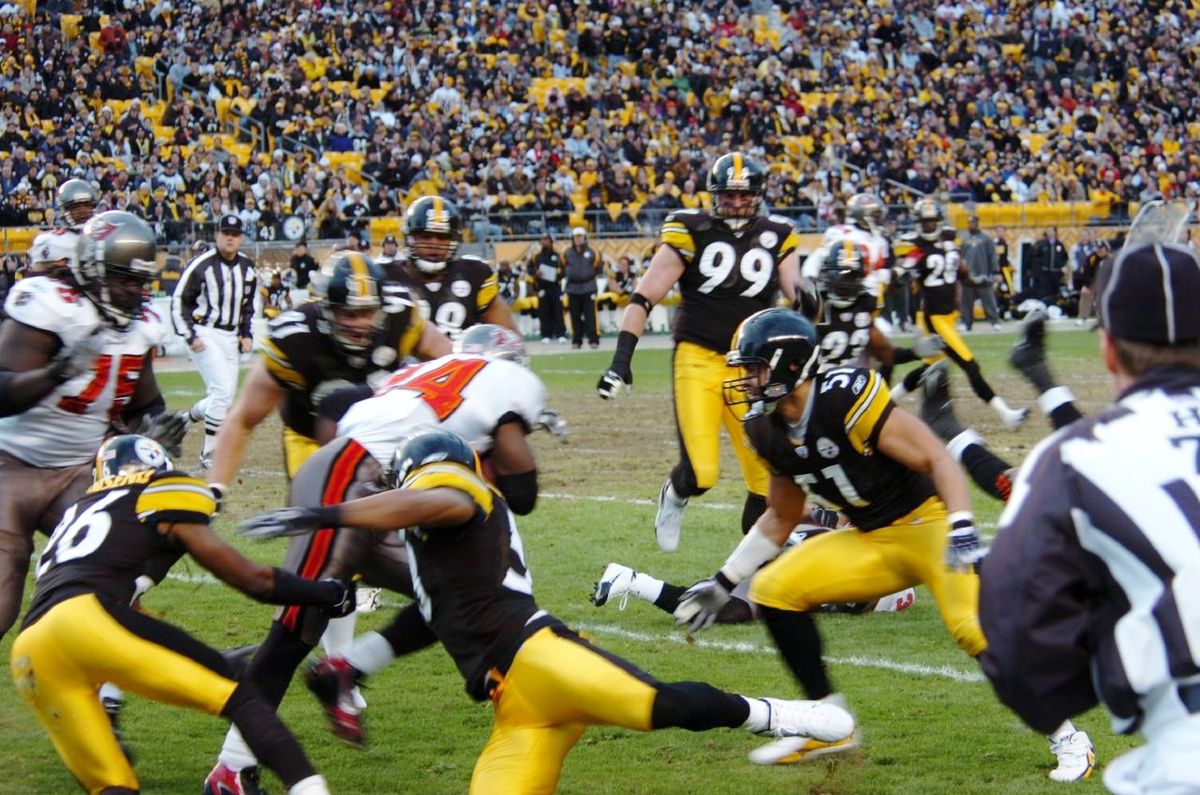
Every Steelers game on the board gets six tables: both sides of the moneyline, both sides of the spread, and the over and under on the total. Each table puts one position side by side at every venue that quotes it. Here is what the columns mean and how each figure is calculated, using one real line: DraftKings' price on the Steelers' next game, at Cincinnati on Sunday night, Nov. 15, as ESPN listed it on Friday afternoon, Nov. 6.
Three ways to price one game
Moneyline. You are picking the winner and nothing else. A minus number marks the favorite and is what you would have to put up to make $100. A plus number marks the underdog and is what $100 earns. DraftKings had the Bengals at -180 and the Steelers at +150: $180 on Cincinnati to make $100, or $100 on Pittsburgh to make $150. The same listing shows the line opened at -192 and +160, so it has moved slightly toward the Steelers since.
Spread. The favorite gives points and the underdog gets them. DraftKings had Cincinnati -3.5. The Bengals have to win by four or more for that side to cash; the Steelers cash by winning outright or losing by three or fewer. In the NFL the half point sits on top of the most common margin in the sport, a field goal, which is why a move from 3 to 3.5 draws so much attention. Both sides were priced at -110, the standard sportsbook price on a spread.
Total. Ignore who wins and add the two scores. DraftKings had this one at 47.5, -110 on each side. The over needs 48 combined points; the under needs 47 or fewer. Pittsburgh's eight games have produced between 23 and 57 points, and its last two, against New Orleans and Cleveland, both went under their totals.
These are examples of how the board reads, not a recommendation, and the numbers will have moved by the time you read this.
The per-$100 column
American odds and contract prices don't compare at a glance, so the board turns every quote into one number: the profit on a winning $100 position.
- Plus odds: the profit is the number itself. +150 returns $150.
- Minus odds: divide 100 by the odds and multiply by 100. -180 returns $55.56; -110 returns $90.91.
- A prediction-market contract priced at p (38 cents is 0.38) with a fee rate r: profit = 100 / (p × (1 + r × (1 − p))) − 100.
Take a Steelers contract at 38 cents, about +163 in American terms. With no fee, $100 buys 263.16 contracts and a win pays $163.16 in profit. At Kalshi's 7% fee rate, part of the $100 goes to the fee, and the profit falls to $152.21. The standard check figure works the same way: a 60-cent contract returns $66.67 with no fee and $62.13 at a 7% rate.
How Novig's fee fits in
Novig's fee depends on when and how you trade, per its published fee schedule:
- Pre-game straight trades on the app or website carry no fee, so that 38-cent Steelers contract bought before kickoff returns the full $163.16 per $100.
- Live (in-game) trades that take a resting order pay a taker fee that scales with price. It is 0.06 × price × (1 − price) per contract, the same rate in every league. At that rate the same 38-cent contract returns $153.72.
- Makers, traders whose resting order is the one that gets filled, pay nothing at any time.
The board prices games before kickoff, which is why Novig's rows there carry no fee.
Best price and the gap
Every table is sorted by the per-$100 figure, highest first, and the leader is tagged Best. Novig is pinned to the first row so you always see it, and each row underneath shows how many dollars it gives up against the leader on the same $100. On the moneyline that comparison is clean. On spreads and totals it holds only when two venues deal the same number; if one book has the Bengals -3.5 and another -3, the row is flagged, because in football those two numbers are not close to the same position.
The hold
If you read one column, read this one. Convert both sides of a two-way market into implied probabilities and add them. A perfectly fair market adds to 100%. Anything above that is what the venue keeps.
DraftKings' moneyline above implies 64.29% for Cincinnati (-180) and 40.00% for Pittsburgh (+150). Together that is 104.29%, a hold of 4.29%. The spread and the total, at -110 on each side, come to 104.76%, a hold of 4.76%. All of it is built in before kickoff.
A prediction market has no house on the other side, so its two sides usually add to within a cent or two of $1. A market with the Bengals at 62 cents and the Steelers at 39 adds to 101 cents, a hold of about 1%, which is simply the gap between the best buy and the best sell on the order book.
The board prints each venue's hold beside its row, from that venue's own two prices at the moment of the fetch. It says nothing about who wins. It tells you what the venue charges to take part.
How fresh the numbers are
The board refreshes roughly every ten minutes. NFL lines move most on injury news, and the Steelers come out of their bye with several players on injured reserve who are eligible to return for this game, so the Wednesday-to-Friday practice reports matter. Use the board to see which venue tends to pay more on which side, then check the live price before you act. The Bengals game page carries the full comparison until kickoff, then turns into the score and, after the final, the recap. The full schedule is on the team page.
This site is for readers 21 and older. If gambling stops being fun, call 1-800-GAMBLER.